Inra    
Quick access :    Quick search :   OK
The institute partnerships Research join us
   

Print

Tip a friend

Contact press

 
Home > Press > Evaluation of cellul ...

Press kit item. 14/02/2006

Evaluation of cellulosic biomass sectors for the production of second generation biofuels


The economic sustainability of the biofuel production industry, and particularly fuels of lignocellulosic origin, requires the long-term utilisation of very large volumes of biomass in limited geographical regions. The REGIX(1) project, in which INRA is a partner, is based on a unified agricultural and forestry approach and aims to ensure that economic actors will have the tools, methods and high quality reference data they need to develop this industry.


There is a strong demand for biofuels and notably for biodiesel in France, and this will continue to grow because the country is currently a net fuel importer, oil prices are still rising and there are political and tax incentives to contribute to reducing pollutant emissions. 
Current methods for biofuel production are based on using oilseeds, cereals or tubers, but these are only available in limited quantities because of the land surface needed for their production.  Methods based on lignocellulose would supplement production and result in a marked increase in the land area involved.

Challenges of the lignocellulosic pathway


When compared with classic biofuel production systems, scenarios based on lignocellulose have three major advantages:
- a wider range of raw materials can be used (whole plants, different residues including those from urban organic growers, forests) will significantly reduce impacts on the greenhouse effect and the exhaustion of fossil energy resources, while ensuring a safer source of industrial supply,
- to achieve equal productivity, lignocellulosic crops, and particularly those of a sustainable nature, require fewer fossil-based inputs than classic annual crops.  This property can minimise local impacts such as water pollution, eutrophication and local and regional effects on air quality,
- the fact that lignocellulosic raw materials can be grown in any region is a major advantage in terms of regional development, particularly in ecologically sensitive zones.
Those involved in research and development need to gain greater knowledge of the lignocellulosic resources which could be available in France. 
For this reason, the REGIX project (Référentiel unifié, méthodes et expérimentations en vue d'une meilleure évaluation du gisement potentiel en ressources lignocellulosiques agricole et forestière pour la bioénergie en France, or unified references, methods and experiments to enable improved evaluation of potential agricultural and forestry lignocellulosic resources for bioenergy in France) was set up in 2005 and funded in the context of the ANR (French Research Agency) National Bioenergy Research Programme.  This project will last for three years and aims to adopt a unified approach (single portal for forestry and agriculture) to the knowledge, methods and techniques concerning lignocellulosic resources necessary to the biofuel industry.

A national database for lignocellulosic resources


First of all, the researchers will develop the first multicriteria reference bank on potential lignocellulosic resources in France.  This will take the form of an on-line database, made available to the scientific, agricultural, forestry and industrial communities and updated as the project progresses. 

An experimental network


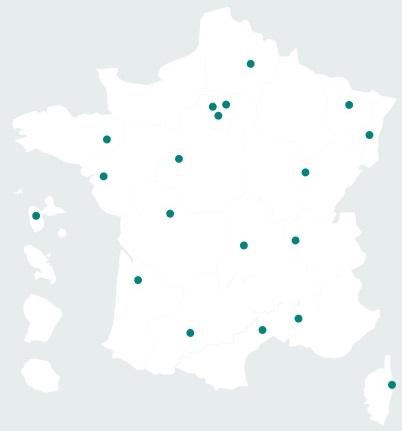
The second stage will be to develop a single agriculture and forestry bioenergy network.  This experimental network, combining small plots with real-sized growing conditions (including a few large agricultural production plots of 3 to 5 hectares to implement harvesting techniques and estimate yields at a sufficient scale), will have sites from north to south of the country, based on the existing networks run by different partners.  The network will be of sufficient size to cover all soil and climate conditions which might be experienced by these resources in the future.  In the context of this project, INRA will be using one of its experimental farms (180 hectares) situated in Mons, which is representative of farming regions in the northern Parisian basin and the major cereal growing regions of Europe.


webMiscant.JPG

Miscanthus trial on the INRA farm
©INRA/S.Cadoux ref : PCD9044-IMG0067.PDC


The resources to be studied are dry by-products such as straw (straw cereals, maize, etc.), classic annual crops harvested as whole plants (such as triticale), classic perennial crops harvested annually (such as alfafa or fescue grass), new perennial crops harvested annually (miscanthus, switchgrass, etc.), known short rotation coppicing species (poplars, eucalyptus, etc.) and forests containing a variety of species for the production of forest woodchips.
These experiments will enable modelling of the biomass growth of little documented species, and an adaptation of cropping and sylvicultural cycles to energy use, which could result in their introduction into cropping systems.  Inputs will be limited, various scenarios for use of the resources will be tested using new equipment and organisation systems, and the quality of this raw material will be analysed as a function of criteria of interest to the technology targeted. 

Studies of environmental impact


The environmental and energy impact of production and exploitation techniques will be taken into account and all parameters measured will be used when studying costs.  Similarly, projects which reproduce wood harvesting and logistic chains at a real scale will be implemented alongside the existing network of forest trials. 
The generation of numerous technical data, unit costs and measurements of energy or environmental impact will improve the quality of economic and environmental studies, and analyses of life cycles will make it possible to orientate future research and development activities.

Tools to evaluate lignocellulosic resources


Finally, tools for the quantitative and spatial evaluation of existing and potential sources of lignocellulose will be improved or developed for straw, new dedicated energy crops, short rotation coppicing and forest chips, the aim being to generate mapping tools which can be applied to practical supply basins during studies prior to the implantation of industrial facilities. 

The INRA teams involved include: the Experimental Farm in Mons, the Laon Reims Mons Agronomy Research Unit, the Joint Research Unit for the Environment and Arable Crops in Grignon, the Joint Research Unit for Public Economics in Grignon and the Lille Research Centre. 

(1) In collaboration with the GIE ARVALIS/ONIDOL (project coordinator), Association forêt cellulose (AFOCEL, or the French Forestry Cooperation Union), Office National des Forêts (ONF, or the National Forestry Bureau), Union de la Coopération Forestière Française (UCFF, or the Union of French Forestry Cooperatives), EDF Research and Development, the Regional Chamber of Agriculture for the Centre Region, and the Regional Federation of Agricultural Cooperatives (Fédération Régionale des Coopératives agricoles, FRCA) for Picardy.


Written by :  INRA press service, phone: +33 (0)1 42 75 91 69

Contacts : 
Ghislain  GOSSE
Tel: 03 22 85 75 04 - Ghislain.Gosse@mons.inra.fr
Stéphane CADOUX
Tel : 03 22 85 75 15 - Stephane.Cadoux@mons.inra.fr
Lille Research Centre
 

Browse by subject :

Browse by type of document :

Browse by year :


Search :

Head office: 147 rue de l'Université 75338 Paris Cedex 07 FRANCE - tel: +33(0)1 42 75 90 00 | copyright © INRA 2005 | Credits | Legal notice