Inra    
Quick access :    Quick search :   OK
The institute partnerships Research join us
   

Print

Tip a friend

Contact press

 
Home > Press > Forests of the past

Press Info item. 11/07/2008

Forests of the past: what lessons for tomorrow?


In an article published in Science on June 13, 2008, an INRA researcher and two professors from American universities, reviewed the contribution of knowledge about the history of forests to modelling their future evolution. Past episodes of climate changes, sometimes very violent, have markedly affected forests. Through their work, INRA scientists are contributing to a clearer understanding of key processes in the ancient dynamics of forests: survival at low density or extinction during cold or dry episodes, more or less rapid expansion during periods of warming. These data are of considerable value to testing models for the future dynamics of forests in response to climate change related to human activities.


Some recent advances in our knowledge of the history of forests are based on the increasingly intensive integration of fossil and genetic data available on trees.  For example, work to characterise the genetic structure of spruce populations has shown that these trees survived at higher latitudes than previously supposed during the last maximum cold peak, 18,000 years ago.  This led researchers to review and reduce the rate of tree migration, usually deduced from fossilised pollen data only.  Information concerning the rapidity of forest colonisation, or its ability to sustain itself when conditions become unfavourable, is particularly important to modelling the future distribution of forests. 
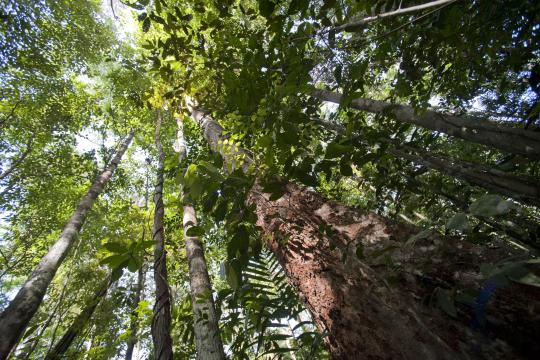
Studying the history of forests should also enable better anticipation of the consequences of biological invasions.  Comparisons using phylogenetic techniques on trees present on both sides of the Atlantic in the tropical forests of Africa and South America have evidenced natural exchanges of seed between the two continents: although these exchanges are rare, at a geological scale they are much more numerous than previously thought.  Scientists have thus been able to observe that tropical forests are not particularly resistant to invasion by new tree species.
Our ability to reconstruct the history of forests has progressed considerably, thanks in particular to cross-disciplinary approaches, but there are clearly some limitations to these "lessons from the past".  In particular, in the history of our planet, it is not possible to find climates and conditions that are rigorously identical to those we are experiencing today and that will prevail in the future.  Nevertheless, the usefulness of validating models for forest dynamics in the context of past climatic conditions remains considerable, because these models cover a broad range of conditions, some of which are very different from those found today.

The recent work at INRA that has enabled these new syntheses of our knowledge focused on two particular points: improving methods to extract ancient, degraded DNA from fragments of wood, and thus reconstructing the history of tree populations using genetic tools; and demonstrating that trees were able to persist during the last maximum cold peak at much northerly latitudes than previously thought.
Studies on ancient DNA have shown that it can sometimes persist in wood fragments that are several thousands of years old.  This work was partly made possible by the expertise acquired at INRA through the study of DNA in tropical timbers and oak used for cooperage.  Issues concerning the traceability of timber are currently relevant in both cases, either to prevent the import of illegal timber from tropical regions, or to guarantee the origin of oak with reputed aromatic traits.  Applied to ancient DNA, these techniques have made it possible to demonstrate the stability of the genetic structure of forests, which to a considerable degree is inherited from the first trees that were established in a region and not from subsequent episodes that changed the density of forests.  Hence the possibility of finding traces of the persistence of small populations of trees in favourable sites, including during the coldest episodes of prior cold peaks.  In collaboration with French, Italian and American paleoecologists, INRA geneticists have thus been able to show that small populations of beech still remained in southern France at a period when prehistoric man was painting seals and penguins on the walls of the Cosquer caves off Marseilles, and that spruce trees continued to grow at very high latitudes, notably in Alaska.


References :
Science 13 June 2008:Vol. 320. no. 5882, pp. 1450 – 1452  DOI: 10.1126/science.1155457
“Forests of the Past: A Window to Future Changes”
Rémy J. Petit, Feng Sheng Hu, Christopher W. Dick


The authors:

►Rémy Petit is a Senior Researcher in the INRA-University of Bordeaux I Joint Research Unit for Biodiversity, Genes and Plant Communities (BIOGECO).  A geneticist by training, he has help to establish closer links between his discipline and paleoecology.  During the early 1990s, he made a major contribution to developing reconstructions of the history of trees using molecular markers.  He then coordinated European projects on the phylogeography and paleogenetics of trees, and led the initial studies that led to the demonstration that DNA could be extracted and amplified from dry wood.  He is currently  working on projects focused on the traceability of oak or tropical timber. 
►Feng Sheng Hu, Professor at the University of Illinois, is a paleoecologist who is studying the response of ecosystems to climate change using retrospective approaches, seeking to reconstruct the history of forests, notably in Arctic regions (Alaska).  He received an Aquitaine/Fulbright scholarship which allowed him to work at BIOGECO (INRA-University of Bordeaux I) in 2007 with Rémy Petit.
►Chris Dick, Professor at the University of Michigan, is a geneticist specialised in the ecology and evolution of tropical forests.  He has been collaborating with BIOGECO in the context of the SEEDSOURCE project (supported by the European Union), the aim of which is to improve the management of neotropical forests.


Written by :  INRA press service, phone: +33 (0)1 42 75 91 69

Contacts : 
Scientific contact :
Rémy PETIT
Tel. : 05 57 12 28 37
remy@pierroton.inra.fr
INRA-Université Bordeaux I Joint Research Unit for Biodiversity, Genes and Plant Communities
Forest, Grassland and Freshwater Ecology Division Bordeaux-Aquitaine Research Centre
 

Browse by subject :

Browse by type of document :

Browse by year :


Search :

Head office: 147 rue de l'Université 75338 Paris Cedex 07 FRANCE - tel: +33(0)1 42 75 90 00 | copyright © INRA 2005 | Credits | Legal notice