Inra    
Quick access :    Quick search :   OK
The institute partnerships Research join us
All about INRA research  | Some examples  | Directories  | Scientific resources


Print

Tip a friend

 
Home > Research > Some examples > Double-muscling trait is decoded in sheep

Press Info item. 27/10/2006

Double-muscling trait is decoded in sheep


In sheep, as in other animal species, there are certain “meat” breeds that exhibit exceptional muscularity. These are used to improve the quality of meat-type animals. For several decades, scientists hypothesised that in the case of some Belgian or Dutch lines of the Texel sheep breed, whose extreme muscle development does not have an effect on meat taste and tenderness, there may exist a “double-muscling” major gene. Over the last 10 years, INRA and Université de Liege have collaborated in a joint research effort to characterise the double-muscling trait and identify the gene responsible for it. Their results point to a new type of gene regulation: a mutation of the gene that encodes myostatin, a protein that naturally limits muscular growth, inhibits the expression of this protein. This in turn causes muscular hypertrophy with the creation of an illegitimate target site for microRNAs on the RNA transcript. This original mutation is of great interest to animal producers.


Muscularity is defined as muscle thickness relative to skeleton dimensions. It is an important economic trait that is evaluated post-slaughter using a carcass quality grading scale. In 1995, a multi-disciplinary project was launched by INRA and Université de Liège (ULG) to characterise the double-muscling phenotype and to search for the gene responsible for it. The project was approved and financed by ANR Genanimal, Apis-Gène and the administrative region of Wallonia in Belgium.

Four years of cross-breeding


To detect the genome region, or locus, likely to contain the muscular hypertrophy gene, researchers from INRA, Clermont-Ferrand-Theix and INRA, Toulouse cross-bred double-muscled Belgian Texel sheep with less muscled Romanov sheep. First, researchers cross-bred Romanov ewes with double-muscled Belgian Texel rams to produce an “F1” population of presumably heterozygous males and females. These animals were then cross-bred among themselves to produce an F2 generation. These crosses were carried out in order to give the experimental population about half of the genes of two different parent breeds, but with high genetic variability if there existed a major gene. In four years, 258 offspring were thus produced.

Researchers took a large number of phenotypic measures on these 258 sheep to characterise body composition, muscle morphology and composition and fat deposits.


Genetic mutation is responsible for double-muscling


First, genetic analysis using 153 microsatellite markers showed that a QTL (Quantitative Trait Locus) on chromosome 2 encompassing the myostatin gene (GDF8) had a major effect on muscle traits. Mutations leading to the loss of function of GDF8 had already been reported in mice, cattle and humans presenting with muscular hypertrophy; this made it an obvious candidate underlying the “Texel gene”. However, neither QTL mapping nor expression analysis of GDF8 messenger RNA revealed any functional polymorphism, and it was abandoned as a candidate.

Researchers pursued their work in the area and were able to identify 11 overexpressed genes in sheep with the Texel QTL. This was done mainly through fine mapping and studying of QTL expression. In addition, proteomic studies were conducted to search for polymorphic expression of proteins linked to the QTL.

In the meantime, myostatin research continued: scientists studied the offspring of two F2 rams with a recombination in a nearby zone of the QTL (2cM), which furthered localisation in a region encompassing GDF8. Upon re-examining the QTL, researchers identified 20 Single Nucleotide Polymorphisms (SNPs) outside of the coding region. Among these 20 mutations, two were specific to double-muscled animals, and one of them showed a frequency of expression of 99% in double-muscled Texel sheep. The mutation appears to disrupt the production of myostatin by creating an illegitimate target site for microRNAs on RNA transcripts, causing them to break down. RNA transcripts are molecules produced from DNA that are recognized by the cell to synthesise proteins. Consequently, myostatin cannot be produced normally and the inhibition of its expression results in muscular hypertrophy.


Valuable mutation for animal production industry


The discovery of this new type of regulation of gene expression provides opportunities for a better understanding of the mechanisms responsible for phenotypic variation.

The mechanism involved here probably regulates the hypertrophy phenotype in such a way that it does not cause a major transformation of the animal’s morphology. Instead, it results in a mutation of agronomic interest which appears to cause an increase in muscle mass in the entire carcass, especially in the hindquarters, and a decrease in fat.

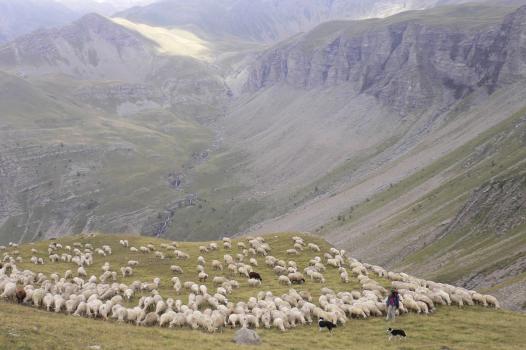
© GEBRO / Didier Grasset

The introgression, or introduction through successive crosses, of this mutation has been ongoing since 2003 in one population of Lacaune sheep (reference: GEBRO, a group of ewe breeders located in southern France).


Source:
A mutation creating a potential illegitimate microRNA target site in the myostatin gene affects muscularity in sheep
Nature Genetics 38, 813 - 818 (2006)

Published online: 4 June 2006; | doi:10.1038/ng1810
http://www.nature.com/ng/journal/v38/n7/abs/ng1810.html
Alex Clop1, 6, Fabienne Marcq1, 6, Haruko Takeda1, 6, Dimitri Pirottin1, 6, Xavier Tordoir1, Bernard Bibé2, Jacques Bouix2, Florian Caiment1, Jean-Michel Elsen2, Francis Eychenne2, Catherine Larzul2, Elisabeth Laville3, Françoise Meish1, Dragan Milenkovic4, James Tobin5, Carole Charlier1 & Michel Georges1

1  Unit of Animal Genomics, Department of Animal Production, Faculty of Veterinary Medicine & Centre for Biomedical Integrative Genoproteomics, University of Liège (B43), 20 Boulevard de Colonster, 4000 Liège, Belgium.
2  INRA - Animal Breeding Unit, BP 52627, 31326 Castanet-Tolosan CEDEX, France.
3  INRA - Quality of Animal Products Unit, Theix, 63122 Saint-Genès-Champanelle, France.
4  INRA/Université de Limoges, Animal Molecular Genetics Unit, 87060 Limoges Cedex, France.
5  Cardiovascular and Metabolic Diseases, Wyeth Research, 87 Cambridge Park Drive, Cambridge, Massachusetts 02140, USA.
These authors contributed equally to this work.


Written by :  INRA press service, phone: +33 (0)1 42 75 91 69

Contacts : 
Elisabeth LAVILLE
tel.: 33 (0)4 73 62 48 34 or 33 (0)4 73 62 41 99
elaville@clermont.inra.fr
Quality of Animal Porducts Unit, Science and Process Engineering of Agricultural Products Department,
INRA Research Centre of Clermont-Ferrand-Theix
 

All about INRA research

Some examples

Sort by subject:

Sort by year:


Search:


Directories

Scientific resources

Head office: 147 rue de l'Université 75338 Paris Cedex 07 FRANCE - tel: +33(0)1 42 75 90 00 | copyright © INRA 2005 | Credits | Legal notice