| |
See also
|
| |
|
|
The biodiversity of filamentous fungi, the building blocks of sustainable chemistry
(23/03/2006)
|
| ©
Guo Line, Chinese Academy of Sciences, Pycnoporus cinnabarinus |
Improving the energy output and the quality of paper, synthesizing flavours and new texturising agents for food products, developing new areas of biofuels… All of these industrial applications have one point in common: they use the biological activity of fungi (enzymatic functionalisation and/or degradation) involved in the transformation of plant cell walls. These fungi, responsible in their natural state for the degradation of wood, have a wide biological diversity that varies according to the region of the world where they are found and, thus, an extraordinary potential for industrial applications. To develop this potential, INRA is focusing on learning more about their biology and their activity in relation to knowledge about the organisation of plant cell walls.
|
| |
A reservoir of bioproducts and biotransformations
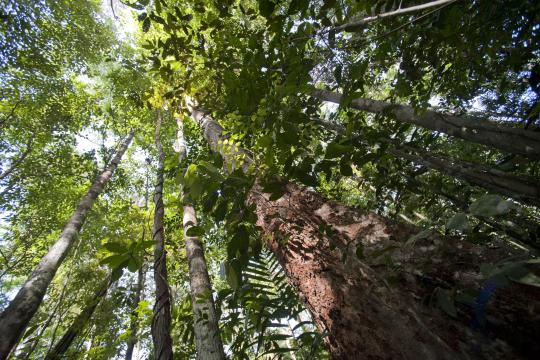
China and France have some of the largest reservoirs of biodiversity on the planet thanks to the tropical forests of Hainan, Guangxi and Guyana. Almost 75,000 species of filamentous fungi are known at this time, but there could be thousands more. Fungi that break down wood in these tropical zones are five to ten times more effective than those found in temperate zones. These fungi could be used for many industrial applications in areas as varied as agro-food, paper and biofuels.
For example, they could be used to produce biotechnological vanillin or vegetal texturising gels that could be substituted for animal gelatine. Pycnoporus cinnabarinus, for instance, is a white rot of wood that has key metabolic pathways for the production of flavours and antioxidants. This fungus was selected as a laboratory model by INRA in Marseille.
The Joint Research Unit for Biotechnology of Filamentous Fungi (INRA-Universities of Aix-Marseille I and II) studies the role of enzymes, for example, laccase, a "blue" copper mettaloenzyme that can be produced from different fungi. It was demonstrated that paper produced using laccase led to a 30% gain in energy, used 50% less chemical products and was more resistant to tearing.
Trichoderma reesi is a fungus that was isolated during the war in Viet Nam where it was found to degrade soldiers' uniforms. It is used by industry at this time to produce sugar in the bioethanol chain. The laboratory uses it as an industrial model to make this transformation more cost-effective.
Research extends from the inventory and characterisation of the diversity of the genes of filamentous fungi and of their functions (functional biodiversity), to the development of enzymes and nanosomes (complexes of several enzymes), in order to study their properties and make them available to industry.
|
.jpg) |
Pycnoporus cinnabarinus
© Guo Line, Chinese Academy of Sciences
|
Lentinus tigrinus
© Inra
|
International cooperation for the protection and application of biodiversity
INRA and the Chinese Academy of Sciences (CAS), in partnership with CIRAD, are pooling their knowledge to work on fungi that break down lignins. INRA in Marseille created the Centre Français des Ressources Fongiques (French Centre of Fungal Resources) and established the UNESCO Chair in Food and Environment Biotechnology for sustainable development (BIODEV). The latter is dedicated to both research and teaching. It facilitates cooperation between INRA (Marseille) – and its Chinese counterpart – and the IRD (French Research Institute for Development) with its partnerships in Morocco, Brazil and Mexico. It offers long-distance television teaching to students in these countries for both graduate studies and doctoral post-graduate studies with shared supervision.
Its approach to research includes a transversal action that incorporates the knowledge and preservation of microbial biodiversity. It aims at ensuring the protection and development of our microbial genetic heritage using a fungal and bacterial resource bank maintained in France that will duplicate and preserve the rights of the partners of this intercontinental network. The ultimate goal is to obtain an IGP (Protected Geographic Indication) for fungi from Guyana and China.
|
|
Written by :
Communications Department
Contacts :
Marcel Asther, marcel.asther@esil.univ-mrs.fr
Unit :
Biotechnology of Filamentous Fungi (INRA-Universities of Aix-Marseille I and II), Avignon Research Centre, http://compact.jouy.inra.fr/compact/CONSULTER/INTER/ externe/unites/ecrans/1163
Department :
Science and Process Engineering of Agricultural Products, http://compact.jouy.inra.fr/ compact/CONSULTER/INTER/external/departements/ecrans/52
Label for the news :
Research example
Date of creation : 05/05/2006
Date of last update : 05/09/2008
|
|
|
|