|
8,488 staff
-
8,488 tenured staff members as of 31 December 2010, 49.6% of whom are women.
1,837 scientists, 2,590 engineers, 4,061 technicians and administrative staff.
Much INRA research requires technical or experimental facilities for crops of agricultural interest or livestock. Because staff with appropriate training are needed to run these facilities, INRA has a higher percentage of technical staff than most other research organisations.
-
Nearly 2,000 PhD students at INRA in 2010 and a large number of Masters and postdoctoral students, including 46 foreign Masters students and 102 foreign postdoctoral students financed by INRA, as well as 48 postdoctoral students financed by the Ministry of Research. These future researchers actively contribute to research at INRA whilst receiving training.
14 research divisions, 19 regional centres, strong scientific partnerships
-
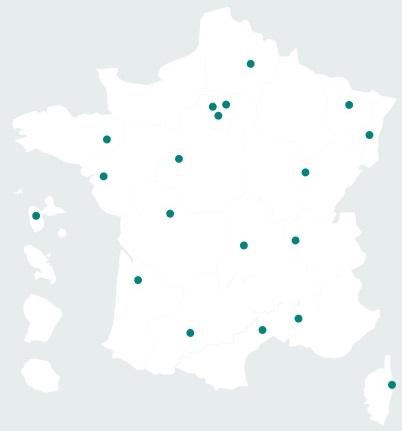
19 regional centres involved in 21 clusters and nearly 150 research and experimentation sites in France, including overseas France.
-
14 research divisions specialising in agriculture, food and nutrition, and the environment.
-
213 research units, including 112 joint research units associated with other research or higher education institutions.
-
INRA is involved in 43 contract-based units (in the form of financial support).
Results
Scientific publications
-
The analysis of the citations of articles published between 1998 and 2008 shows that INRA is one of the 1% of most cited institutions (1).
-
For the number of citations, INRA maintains its second position in the world in the two fields at the heart of its mission "Plant and Animal Sciences" and "Agricultural Sciences" and is placed among the first organisations in the world (top 10%) in "Microbiology" and "Environment and Ecology".
-
The percentage of INRA co-publications with international partners increased from 34% in 2001 to nearly 39% in 2010.

Source: INRA's Annual Report 2010 p.8
Partnerships with industry and innovation
-
266 research contracts signed with the private sector, including 20 new contracts with Cifre grantholders in 2010 and 7 PhDs cofinanced by INRA and an industrial partner
262 basic patents have been filed in France, including 41 in 2010 (17% more than in 2009).
193 software programs and databases, including 33 in 2010.
377 licences in total (52 of which were signed in 2010), for patents, know-how, software, databases and trademarks, managed by Inra Transfert.
-
475 varieties are protected by Plant Breeder’s Rights: field crop, fodder, vegetable and ornamental varieties, as well as fruit trees, forest trees and grapevines, including 18 new ones in 2010. 35 new licences were granted in 2010 by Agri-Obtentions, INRA’s subsidiary in charge of the commercial development of new plant varieties.
- 20 competitiveness clusters involving INRA, including 2 international clusters.
- 22 joint technological units involving INRA.
- 24 joint technological networks.
- INRA is involved in coordinating 3 Scientific Interest Groups with players from the production sectors and is coordinating the Agronomic Stimulus Scientific Interest Group bringing together Research-Training-Development partners for sustainable agriculture.
Partnerships with universities
- Participation of INRA teams in more than 100 doctoral schools.
- Privileged partnerships with 7 doctoral schools.
- About 25,000 teaching hours by INRA scientists and engineers, mainly at Masters and PhD level.
European Research Area and International
- 551 projects submitted to the 7th Framework Programme for Research and Development with 174 projects selected, which is a 31.5% success rate: INRA is coordinating 46 projects (excluding individueal grants) and is participating in 113 others, principally on the subject of "Food, agriculture and biotechnologies".
- 6,250 international cooperation assignments, 1,864 of which were in Mediterranean countries, including Mediterranean countries of the European Union.
- In 2010, INRA hosted 1,839 foreign researchers, 657 of whom came from Mediterranean countries including Mediterranean countries of the European Union.
Financial resources
- €813 million budget for 2010.
- 79% of INRA's resources come from the Ministry of Higher Education and Research and the Ministry of Agriculture and Fisheries, 14.8% are from grants or funds for research activities or contracts, 6.2% from provision of services, symposia and product sales.
- Staff costs represent 70% of expenditure, operating costs 17%, collective infrastructure and computer services 9% and property costs 4%.
(1) In order to improve the readability of its activities, INRA has decided to design, in partnership with the Observatoire des Sciences et Techniques (OST), a system for producing standardised bibliometric indicators based on tools and data from the Thomson Reuters international base.
|